
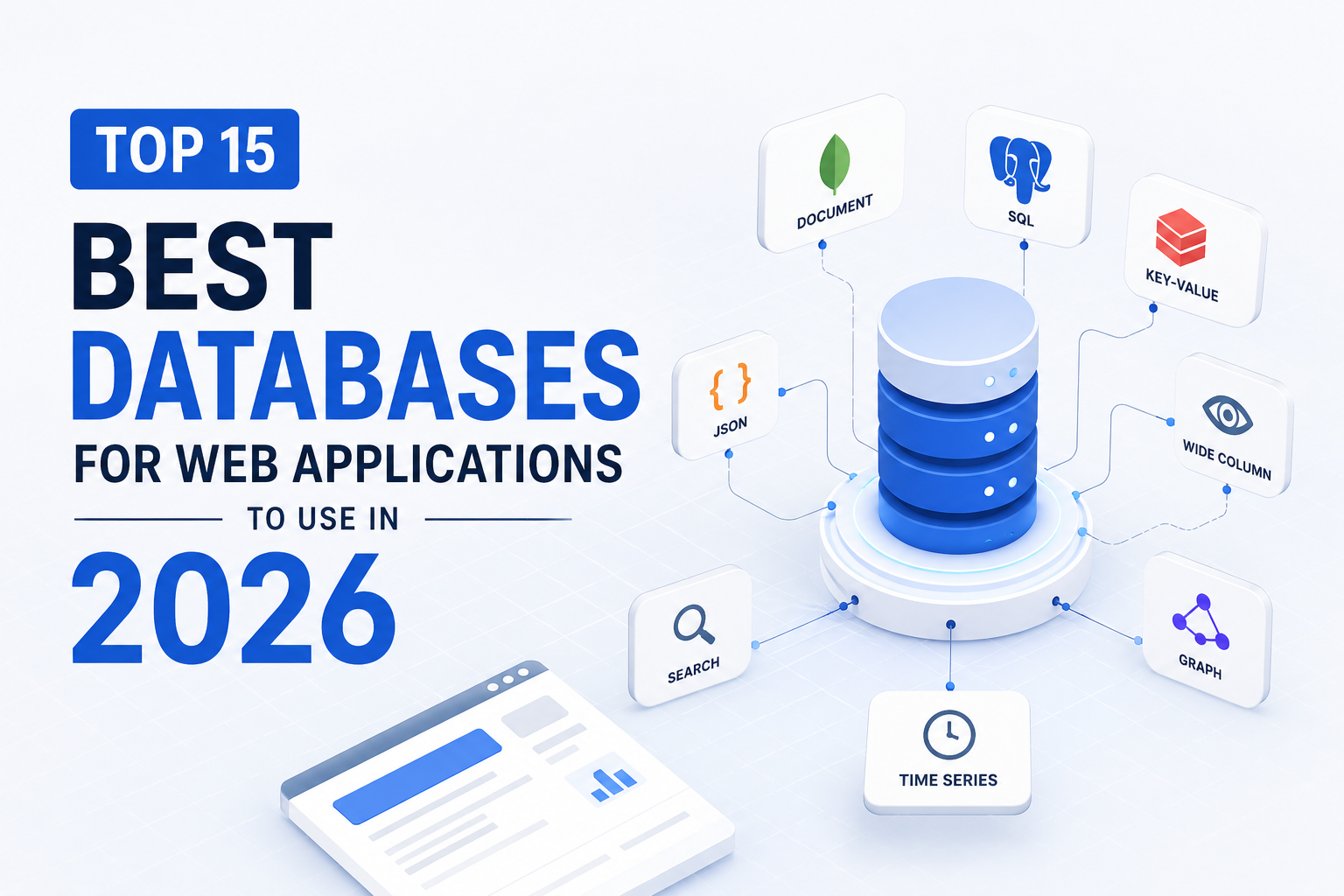
Best databases for web applications 2026 are essential for building fast, scalable, and secure modern applications. Every modern web application runs on data, whether you’re streaming videos, processing payments, or using social media platforms.
Whether you’re streaming videos, managing online payments, booking flights, collaborating with teammates, or scrolling through social media, there’s a database working behind the scenes to process and deliver information in real time.
Databases have evolved far beyond their original purpose of storing and retrieving records. In 2026, they serve as the foundation of modern software architecture, powering everything from AI-driven applications and SaaS platforms to enterprise systems and global e-commerce marketplaces.
Today’s databases can automatically scale during traffic surges, replicate data across regions, optimize queries with machine learning, and provide near-instant access to massive datasets. As applications become more complex and user expectations continue to rise, choosing the right database has become one of the most important decisions developers and businesses make.
The database you select affects far more than storage. It directly influences application performance, security, scalability, reliability, development speed, infrastructure costs, and long-term maintainability.
In this guide, you’ll learn:
- Why databases are essential for modern web applications
- The differences between SQL and NoSQL databases
- Key factors to consider before selecting a database
- The top 15 databases powering web applications in 2026
- Best practices for performance and security
- Future trends shaping the next generation of databases
Whether you’re building a startup MVP, an enterprise SaaS platform, an e-commerce application, or a large-scale social network, understanding today’s database landscape will help you make a more informed decision.
Why Best Databases for Web Applications 2026 Matter
A database is the engine that keeps a web application running.
Without an efficient database, even the most beautifully designed application can suffer from slow loading times, failed transactions, poor user experiences, and costly security vulnerabilities.
Modern The best databases for web applications 2026 play a critical role in performance, scalability, and security. in four key areas: performance, scalability, security, and data integrity.
Faster Performance and Better User Experience
Speed has become a competitive advantage.
Users expect web applications to respond instantly. A delay of only a few seconds can increase bounce rates, reduce conversions, and negatively impact customer satisfaction.
Databases contribute significantly to application speed by:
- Processing queries efficiently
- Retrieving information quickly
- Reducing response times
- Supporting high volumes of simultaneous users
- Enabling real-time functionality
Popular platforms such as streaming services, online marketplaces, and social media networks rely heavily on optimized database architectures to maintain seamless user experiences across millions of daily interactions.
When properly configured, modern databases can process thousands—or even millions—of requests every second while maintaining low latency.
Scalability for Business Growth
As applications grow, so does the amount of data they must handle, what works for a startup with 1,000 users may struggle when the platform reaches one million users.
Scalability determines how effectively a database can accommodate growth without sacrificing performance.
There are two primary approaches to scaling:
Vertical Scaling
Vertical scaling increases the resources of a single server by adding:
- More CPU power
- Additional memory
- Faster storage
This approach is common among traditional relational databases and works well until hardware limitations are reached.
Horizontal Scaling
Horizontal scaling distributes workloads across multiple servers, Instead of upgrading one machine, additional nodes are added to share the workload.
Benefits include:
- Greater fault tolerance
- Improved availability
- Better support for massive workloads
- Easier global distribution
Many modern NoSQL databases were designed specifically for horizontal scaling, making them popular choices for high-growth applications.
Stronger Security and Data Protection
Databases often contain an organization’s most valuable information.
Customer records, payment data, employee information, analytics, and proprietary business data must all be protected against unauthorized access.
Modern databases help safeguard sensitive information through:
- Data encryption
- Access controls
- Authentication systems
- Activity monitoring
- Audit logging
- Threat detection
As cyberattacks continue to increase globally, security is no longer optional. Businesses must prioritize database solutions that provide robust protection while maintaining regulatory compliance.
Data Integrity and Reliability
Accurate data is essential for business operations, so Imagine an online banking platform displaying incorrect balances or an e-commerce website processing duplicate orders.
Database integrity mechanisms help ensure:
- Transactions are completed correctly
- Records remain consistent
- Data remains accurate during failures
- Systems recover safely after disruptions
This is particularly important in industries such as healthcare, finance, insurance, government, and education, where data accuracy directly affects business operations and regulatory compliance.
SQL vs NoSQL Databases: Understanding the Difference
One of the first decisions developers face is choosing between SQL and NoSQL databases.
While both are designed to store and manage information, they solve different problems and support different application requirements.
Understanding their strengths and limitations will help you determine which approach aligns best with your project.

What Are SQL Databases?
SQL (Structured Query Language) databases store information in organized tables consisting of rows and columns.
Each table follows a predefined structure known as a schema.
Examples include:
- MySQL
- PostgreSQL
- Microsoft SQL Server
- Oracle Database
- MariaDB
SQL databases are ideal for applications that require:
- Strong consistency
- Complex relationships
- Structured data
- Financial transactions
- Reporting systems
Advantages of SQL Databases
- Mature ecosystem
- Strong ACID compliance
- Excellent data integrity
- Powerful query capabilities
- Well-suited for transactional workloads
Limitations of SQL Databases
- Less flexible schemas
- Horizontal scaling can be more challenging
- May require additional infrastructure for massive workloads
What Are NoSQL Databases?
NoSQL databases were designed to handle modern data requirements that traditional relational systems often struggle with.
Rather than storing information exclusively in tables, NoSQL databases can use:
- Documents
- Key-value pairs
- Wide columns
- Graph structures
Popular examples include:
- MongoDB
- Redis
- Cassandra
- DynamoDB
- Neo4j
NoSQL databases excel when applications require:
- High scalability
- Flexible data structures
- Real-time processing
- Distributed architectures
- Rapid development cycles
Advantages of NoSQL Databases
- Flexible schemas
- Easier horizontal scaling
- High availability
- Faster development for dynamic applications
- Excellent support for large datasets
Limitations of NoSQL Databases
- May sacrifice consistency in some scenarios
- Query capabilities can vary significantly
- Data relationships may require additional handling
Key Factors for Choosing Best Databases for Web Applications 2026
Selecting a database should never be based solely on popularity.
The right database depends on your application’s unique requirements, expected growth, budget, security needs, and technical architecture.
Here are the most important factors to evaluate before making a decision.
1. Performance
Performance determines how quickly a database can process requests and return results.
Consider:
- Query speed
- Read performance
- Write performance
- Concurrent user support
- Real-time processing requirements
Applications that depend on fast response times should prioritize databases known for low latency and efficient query execution.
2. Scalability
Think beyond today’s requirements.
Ask yourself:
- How many users do you expect next year?
- How much data will the application generate?
- Will traffic spikes be common?
A database that scales effectively can save significant infrastructure costs and prevent future migrations.
3. Security
Security should be a core consideration from day one.
Look for features such as:
- Encryption at rest
- Encryption in transit
- Multi-factor authentication
- Role-based access controls
- Compliance certifications
- Automated auditing
Organizations handling sensitive information should place security among their highest priorities.
4. Cost
Database costs can vary dramatically.
Factors affecting cost include:
- Licensing fees
- Cloud hosting expenses
- Storage consumption
- Backup requirements
- Operational maintenance
Open-source databases often reduce licensing costs, while managed cloud services reduce administrative overhead.
5. Ease of Integration
A database should work seamlessly with your existing technology stack.
Consider compatibility with:
- Programming languages
- Frameworks
- APIs
- CI/CD pipelines
- Analytics platforms
- Cloud environments
Strong integration support can significantly reduce development complexity.
6. Cloud vs On-Premises Deployment
Modern organizations can choose between cloud-hosted and self-managed deployments.
Cloud Databases
Advantages:
- Automatic scaling
- Reduced maintenance
- Automated backups
- Faster deployment
On-Premises Databases
Advantages:
- Greater control
- Custom infrastructure
- Enhanced regulatory compliance options
- Full ownership of data environments
The right choice depends on business requirements, security obligations, and operational preferences.
By carefully evaluating these factors, businesses can choose a database that supports current requirements while remaining flexible enough to accommodate future growth.
The modern web development ecosystem offers dozens of database solutions, but only a handful consistently power the world’s most successful applications. The best choice depends on your application’s architecture, scalability requirements, data structure, and performance goals.
Below are eight of the most widely used and trusted databases for modern web applications.
1. MySQL
MySQL remains one of the most popular databases in the world, and for good reason. It is reliable, mature, easy to learn, and supported by virtually every major hosting provider and cloud platform.
For startups, SaaS products, content management systems, and e-commerce websites, MySQL continues to be a dependable choice.
Its strong community support, extensive documentation, and broad ecosystem make it particularly attractive for businesses looking to launch quickly without sacrificing reliability.
Key Features
- Open-source and free to use
- ACID-compliant transactions
- Replication and clustering support
- Strong indexing capabilities
- Broad hosting and cloud support
Best For
- SaaS applications
- E-commerce platforms
- Content management systems
- Business applications
- Customer portals
| Pros | Cons |
|---|---|
| Easy to learn and manage | Horizontal scaling can become complex |
| Large developer community | Not ideal for highly distributed architectures |
| Excellent documentation | |
| Strong performance for transactional workloads |
Notable Users
Many large-scale technology companies continue to use MySQL as part of their infrastructure due to its reliability and performance.
2. PostgreSQL
PostgreSQL is often considered the most advanced open-source relational database available today.
While MySQL focuses on simplicity and speed, PostgreSQL emphasizes flexibility, extensibility, and advanced capabilities.
Developers frequently choose PostgreSQL when applications require complex queries, analytics, custom data types, or support for both structured and semi-structured data.
Key Features
- Advanced SQL support
- JSON and JSONB storage
- Full-text search
- Custom functions and extensions
- Strong ACID compliance
Best For
- Enterprise applications
- SaaS platforms
- Financial systems
- Data analytics
- GIS and location-based applications
| Pros | Cons |
|---|---|
| Extremely powerful query engine | Slightly steeper learning curve |
| Excellent reliability | More advanced configuration requirements |
| Flexible data handling | |
| Strong security features |
Notable Users
Many modern SaaS companies rely on PostgreSQL because it combines relational database reliability with NoSQL-like flexibility.
3. Microsoft SQL Server
Microsoft SQL Server is designed for organizations that require enterprise-grade performance, security, and integration within the Microsoft ecosystem.
It is particularly popular among large businesses already using Microsoft Azure, Windows Server, Power BI, and other Microsoft technologies.
The platform includes advanced analytics, automated management tools, and robust security controls.
Key Features
- Advanced reporting tools
- Deep Azure integration
- Built-in analytics
- Enterprise security features
- High availability options
Best For
- Large enterprises
- Financial institutions
- Government organizations
- Corporate business systems
| Pros | Cons |
|---|---|
| Excellent enterprise support | Licensing costs can be expensive |
| Powerful management tools | Less attractive for small startups |
| Strong security architecture | |
| Reliable performance |
Notable Users
Large organizations and enterprise software providers frequently choose SQL Server for mission-critical systems.
4. Oracle Database
Oracle Database remains one of the most powerful enterprise database solutions available.
It is designed for organizations handling enormous volumes of data where reliability, availability, and security are non-negotiable.
Oracle is widely used across banking, telecommunications, healthcare, and government sectors.
Key Features
- Autonomous database capabilities
- Advanced security controls
- Multi-model support
- High availability architecture
- Automated performance optimization
Best For
- Enterprise applications
- Financial systems
- Government platforms
- Mission-critical workloads
| Pros | Cons |
|---|---|
| Exceptional reliability | High licensing costs |
| Industry-leading security | Requires experienced administrators |
| Excellent scalability | |
| Advanced automation tools |
Notable Users
Many of the world’s largest financial institutions and government agencies depend on Oracle for their core systems.
5. MariaDB
MariaDB originated as a community-driven alternative to MySQL and has since evolved into a powerful database platform in its own right.
It maintains strong compatibility with MySQL while introducing additional performance improvements and enterprise features.
For organizations seeking an open-source database with enhanced capabilities, MariaDB is often a compelling option.
Key Features
- MySQL compatibility
- Advanced storage engines
- Improved performance optimization
- Replication support
- Open-source licensing
Best For
- Web applications
- SaaS platforms
- Business systems
- Organizations migrating from MySQL
| Pros | Cons |
|---|---|
| Free and open source | Smaller ecosystem compared to MySQL |
| Strong performance | Some compatibility differences exist |
| Active development community | |
| Easy migration from MySQL |
Notable Users
Numerous high-traffic websites and digital platforms use MariaDB to support their workloads.
6. MongoDB
MongoDB is one of the most popular NoSQL databases in the world.
Instead of storing information in rigid tables, MongoDB uses flexible JSON-like documents that can evolve as application requirements change.
This flexibility makes MongoDB particularly attractive for startups and rapidly evolving products.
Key Features
- Document-oriented architecture
- Horizontal scaling
- Flexible schemas
- High availability
- Real-time analytics support
Best For
- Social platforms
- Content management systems
- Mobile applications
- Real-time applications
- Startup products
Pros
- Fast development cycles
- Flexible data structure
- Easy horizontal scaling
- Cloud-friendly architecture
Cons
- Complex transactions can be more challenging
- Requires careful data modeling
Notable Users
Many large-scale digital platforms use MongoDB to handle massive volumes of dynamic user-generated content.
7. Redis
Redis is not a traditional database in the same sense as MySQL or PostgreSQL.
It is an in-memory data store optimized for speed.
Because data is stored primarily in memory, Redis can process requests in milliseconds, making it one of the fastest database technologies available.
Developers frequently use Redis for caching, session management, real-time analytics, and messaging systems.
Key Features
- In-memory architecture
- Ultra-low latency
- Data persistence options
- Pub/Sub messaging
- Distributed caching
Best For
- Caching layers
- Real-time applications
- Gaming platforms
- Analytics systems
- High-performance APIs
Pros
- Extremely fast
- Easy to deploy
- Reduces database load
- Supports multiple data structures
Cons
- Memory costs can increase quickly
- Not ideal as the sole database for complex applications
Notable Users
Many of the world’s largest social media and technology platforms use Redis to accelerate application performance.
8. SQLite
SQLite is one of the most lightweight and widely deployed databases ever created.
Unlike traditional databases, SQLite does not require a dedicated server. Everything is stored inside a single file, making deployment remarkably simple.
Despite its simplicity, SQLite remains incredibly reliable and powers billions of devices worldwide.
Key Features
- Serverless architecture
- Zero configuration
- Lightweight deployment
- ACID compliance
- Single-file database storage
Best For
- Mobile applications
- Desktop software
- Embedded systems
- Small web applications
- Prototyping projects
Pros
- Extremely lightweight
- Easy setup
- Minimal maintenance
- Fast local operations
Cons
- Limited scalability
- Not suitable for large concurrent workloads
Notable Users
Many mobile applications, browsers, IoT devices, and embedded systems rely on SQLite for local data storage.
Which Database Should You Choose?
While all eight databases above are excellent choices, they serve different purposes.
- Choose MySQL if you want simplicity, reliability, and broad support.
- Choose PostgreSQL if you need advanced features and flexibility.
- Choose SQL Server for enterprise Microsoft environments.
- Choose Oracle Database for mission-critical enterprise workloads.
- Choose MariaDB for an open-source alternative to MySQL.
- Choose MongoDB for flexible document-based applications.
- Choose Redis when speed and caching are your highest priorities.
- Choose SQLite for lightweight and embedded projects.
The best database isn’t necessarily the most popular one—it’s the one that aligns with your application’s requirements, growth plans, and infrastructure strategy.
Frequently Asked Questions (FAQs)
Which database is best for web applications in 2025?
Whether a database suits your needs depends entirely on the nature of the web application. PostgreSQL and MySQL widely use structured data, whereas DynamoDB, MongoDB, etc., are used for their high scalability. In general, enterprise applications depend on Oracle or Microsoft SQL Server for their high performance and robust security.
How do I choose between SQL and NoSQL?
You may choose a NoSQL or SQL database based on the application’s needs and data structure. An SQL database is the right fit for applications that need complex queries, strong consistency, and structured data, while NoSQL databases are great for managing semi-structured or unstructured data and offer better flexibility and scalability.
What is the fastest database for web apps?
Redis is considered one of the speediest databases, thanks to its in-memory data processing. MySQL and PostgreSQL also deliver high-speed performance with query optimization and proper indexing, making them the right databases for speed-sensitive apps.
Are cloud databases better than traditional ones?
On-premises databases provide robust security and great control and are preferred in enterprises with strict compliance needs. Cloud-based databases, on the other hand, have less infrastructure costs, automatic updates, and scalability, which makes them ideal for modern applications. What you choose depends entirely on your organizational scalability and priority goals.